
In the late 1980s, India’s advertising industry witnessed one of the most fascinating brand transformations—driven by strategic celebrity endorsements and bold creative decisions. The story of Cinthol soap, owned by the Godrej Group, is a perfect example of how marketing innovation and timing can redefine a brand’s identity.
The Beginning: Imran Khan as Cinthol’s Face
The year was 1987. At the peak of his popularity, Pakistani cricket star Imran Khan was chosen as the brand ambassador for Cinthol soap. His charisma, athletic appeal, and massive fan following—especially among women—made him a compelling choice.
At that time, the Indian soap market was highly competitive, with brands like Rexona (by Hindustan Unilever) dominating consumer attention. Parmeshwar Godrej, wife of Adi Godrej, personally oversaw the advertising strategy for Cinthol. Her vision was clear: create a powerful advertisement that would appeal primarily to women.
An initial ad campaign featuring a model was shot, but it failed to meet expectations. Dissatisfied, Parmeshwar Godrej brought in ad filmmaker Shantanu Shorey and asked him to rework the content. However, after reviewing the footage, Shorey rejected it outright, suggesting a complete reshoot.
The Jaipur Shoot: A Race Against Time
The revised concept featured Imran Khan at the center. During the 1987 Cricket World Cup—co-hosted by India and Pakistan—Imran Khan visited Jaipur. This presented a unique opportunity to shoot the ad.
With only 45 minutes available before a match at Sawai Mansingh Stadium, Shorey and his team executed the shoot swiftly. Despite the time constraint, the final ad was impactful and soon aired on Doordarshan.
The response was overwhelming. The campaign significantly boosted Cinthol’s sales and forced competitors to rethink their strategies. Industry insiders believed that Imran Khan’s presence had elevated the brand to a new level.
The Sudden Setback: Political Tensions
However, geopolitical realities soon disrupted the campaign. As India-Pakistan relations deteriorated again, the ad featuring Imran Khan had to be withdrawn. This created a major challenge for the brand—how to maintain momentum without its star face?
The Turning Point: Enter Vinod Khanna
Determined to keep the campaign alive, Parmeshwar Godrej explored new options. During a crucial meeting with a foreign ad agency, a family-oriented concept was proposed—but it failed to impress her.
At this point, Shantanu Shorey suggested the name Vinod Khanna. The Bollywood star had recently returned from a spiritual retreat in the United States and was making a comeback in films. His renewed public image and rising buzz made him an ideal candidate.
Despite skepticism from others in the meeting, Parmeshwar Godrej approved the idea immediately.
The Iconic Beach Ad Shoot
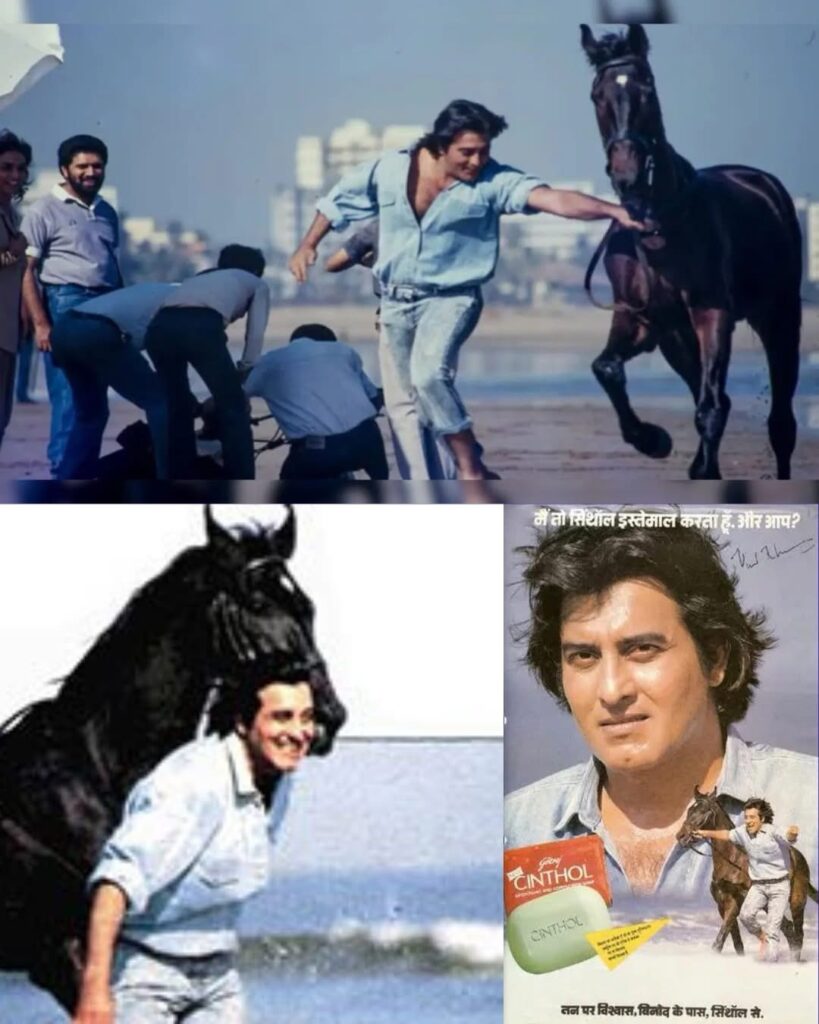
The concept for the new ad was bold and visually striking. Vinod Khanna would be shown riding a horse along the beach at sunrise, dressed in blue denim and shirt—symbolizing masculinity, freedom, and freshness.
The shoot was scheduled at Juhu Beach. However, on the first day, Vinod Khanna arrived late, missing the crucial sunrise lighting. Director Shorey insisted on rescheduling, emphasizing the importance of natural light.
To ensure success, Vinod Khanna stayed overnight at the Godrej beach house. The next morning, the shoot was completed efficiently, including a dynamic sequence where Khanna runs alongside a horse and leaps onto it—captured perfectly after multiple takes.
Additional scenes, including one with Khanna stepping out of a Mercedes in a black suit, were also filmed at the same location.
The Result: A Game-Changing Campaign
Released in 1989, the Vinod Khanna Cinthol ad became an instant hit. The tagline, “I use Cinthol. Do You?”, resonated strongly with audiences.
Consumers began asking for “Vinod Khanna wala soap” at stores—a clear indicator of the campaign’s success. Not only did the ad boost Cinthol’s market position, but it also played a role in reviving Vinod Khanna’s stardom. The journey of Cinthol’s advertising—from Imran Khan’s international appeal to Vinod Khanna’s cinematic charisma—demonstrates the power of adaptability in marketing. It highlights how brands must evolve with changing circumstances while staying aligned with consumer sentiment.
Even today, these campaigns are remembered as benchmarks in Indian advertising history—proof that the right mix of creativity, timing, and star power can create lasting impact.