
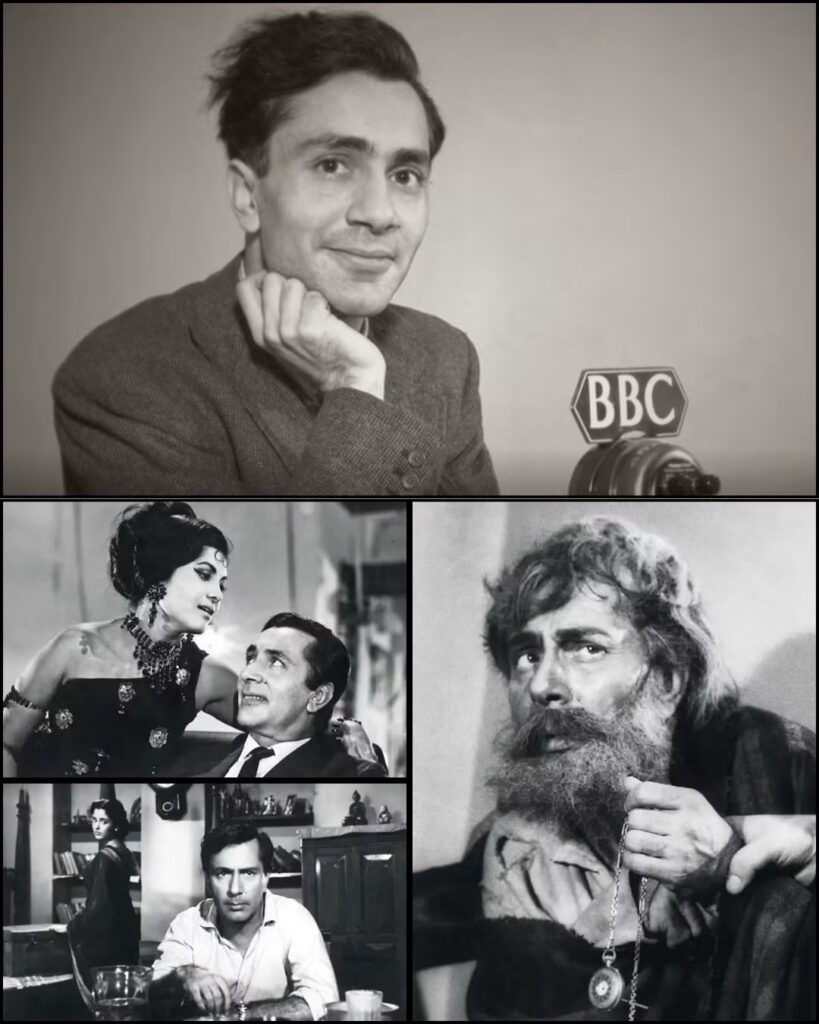
Few actors in Indian cinema have been admired not only for their acting skills but also for their intellect, humanity, and commitment to social causes. Among those rare personalities stands Balraj Sahni, an actor whose life was filled with struggles, heartbreak, political activism, literary pursuits, and extraordinary dedication to his craft.
Many people know Balraj Sahni as the unforgettable actor from classics such as Do Bigha Zamin, Seema, Kabuliwala, Waqt, Anupama, Ek Phool Do Mali, and Do Raaste. However, behind the celebrated actor was a deeply emotional human being whose personal life was marked by profound sorrow and immense resilience.
Years ago, Balraj Sahni’s son, veteran actor Parikshit Sahni, shared several fascinating memories of his father during an interview with journalist Farhana Farook. Through those memories, we get a rare glimpse into the life of one of Indian cinema’s most respected performers.
A Family Rooted in Literature and Education
Before the Partition of India, Balraj Sahni’s family lived in Rawalpindi, now in Pakistan.
According to Parikshit Sahni, his father married Damayanti Sahni in 1936. During the late 1930s, both Balraj and Damayanti joined Rabindranath Tagore’s Santiniketan as teachers.
Their association with Santiniketan played a major role in shaping their intellectual outlook.
Parikshit Sahni was conceived during this period, while his younger sister Shabnam was born four years later.
One of the most significant influences on Balraj Sahni came directly from Rabindranath Tagore himself. Tagore reportedly advised Balraj to write in his mother tongue, Punjabi.
Inspired by this advice, Balraj learned Gurmukhi script and even purchased a Gurmukhi typewriter to begin writing seriously.
This decision would later contribute significantly to Punjabi literature.
London, BBC, and Exposure to Global Ideas
After Santiniketan, Balraj and Damayanti moved to London to work with the BBC Hindi Service.
Their years in London exposed them to international politics, literature, and cinema.
During this period, they developed a strong interest in Soviet and Russian cinema. Through these artistic and intellectual influences, they also became familiar with Marxist thought and socialist ideas.
In 1943, they returned to India, bringing with them a broader worldview that would shape both their artistic and political lives.
The Beginning of an Acting Career Through IPTA
Balraj Sahni’s acting career did not begin in commercial cinema.
Like many progressive artists of his generation, he entered performance through the Indian People’s Theatre Association (IPTA).
IPTA was much more than a theatre organization. It was a cultural movement that used art, music, theatre, and literature to address social and political issues.
Interestingly, Damayanti Sahni was also an active participant in IPTA productions.
In fact, during those years, Damayanti was often considered more popular and recognizable than Balraj himself.
Balraj later admitted in his autobiography Meri Filmi Aatmakatha that there was a period when he felt jealous of his wife’s growing popularity.
He confessed that this jealousy sometimes affected his behavior.
Even after returning home from work and theatre commitments, Damayanti continued handling household responsibilities, something Balraj later reflected upon with honesty and regret.
Damayanti Sahni: The Woman Behind the Legend
While Balraj Sahni would eventually become a celebrated actor, Damayanti Sahni was already admired for her social work and activism.
According to Parikshit Sahni, his mother was a committed member of the Communist Party and spent much of her time working among underprivileged communities.
She frequently visited slum areas, helping people and participating in welfare activities.
Many times, she would even share meals with the people she was helping.
Unfortunately, this dedication eventually came at a terrible cost.
At some point, Damayanti developed a severe intestinal infection.
Medical treatment was attempted, but the medicines available at the time reportedly had serious side effects on her heart.
Despite Balraj’s efforts to save her, Damayanti passed away in 1947 at just 26 years of age.
The loss devastated the entire family.
Parikshit Sahni was only eight years old when his mother died.
Because of his young age, he later admitted that he did not retain many direct memories of her.
However, relatives later told him how deeply his father had been affected by the tragedy.
A Grief That Never Truly Left Him
Family members recalled that Balraj Sahni was completely shattered after Damayanti’s death.
He would often cry uncontrollably.
According to accounts shared within the family, there were times when he would bang his head against a wall while repeating:
“Dammo is gone. Dammo has left.”
The loss haunted him for years.
Many observers believe that the emotional depth visible in Balraj Sahni’s performances came partly from the immense personal suffering he experienced in real life.
Pain had become something he understood intimately.
A Second Marriage and a New Beginning
In 1951, Balraj Sahni married writer Santosh Chandhok.
Parikshit Sahni has spoken warmly about his stepmother, describing her as an intelligent, caring, and remarkable woman.
The couple later had a daughter named Sanober.
The name carried special significance.
The Sahni family often spent holidays in Kashmir, where pine trees—known as “Sanober”—were abundant.
Inspired by those beautiful landscapes, Balraj named his daughter after the trees he admired.
Sending His Son Away
During the early years of his acting career, Balraj Sahni was still struggling financially.
As a result, he decided to send his son Parikshit to boarding schools.
Parikshit first attended a boarding school in Pune.
Later, he studied in Himachal Pradesh and eventually at St. Stephen’s in Delhi.
Looking back years later, Parikshit admitted that he did not entirely agree with the decision.
He felt children should spend more time with their families.
Growing up in boarding schools, he often felt disconnected from the idea of “home.”
Facing Mockery and Rejection
Like many successful actors, Balraj Sahni faced criticism and ridicule early in his career.
According to Parikshit, many people used to make fun of his father’s appearance.
Some thought he was too thin to become a film hero.
Others mocked his looks altogether.
Yet Balraj never allowed criticism to discourage him.
Instead, he focused on improving his craft.
His strength did not come from conventional glamour.
It came from authenticity.
Political Beliefs and Imprisonment
Balraj Sahni’s political beliefs also brought challenges.
As a member of the Communist Party, he was once jailed.
Even during this difficult period, opportunities continued to arrive.
While he was still facing legal and political difficulties, producer-director K. Asif obtained permission for him to participate in the filming of Hulchul (1951).
Interestingly, Parikshit Sahni also appeared in the film as a child artist.
According to family accounts, the strain of imprisonment had visibly affected Balraj’s health and appearance during this time.
Finally Finding Success
Years of struggle eventually paid off.
The turning point came with the success of Hum Log (1951).
The film established Balraj Sahni as a serious actor and opened doors to larger opportunities.
To celebrate the success of Hulchul, Balraj reportedly took young Parikshit on a motorcycle trip to Pune, where the two enjoyed lunch together.
It was a simple moment, but one that remained special in his son’s memory.
The Golden Years
The 1950s and 1960s became the most productive decades of Balraj Sahni’s career.
He delivered memorable performances in films such as:
- Seema
- Sone Ki Chidiya
- Lajwanti
- Ghar Sansar
- Kabuliwala
- Waqt
- Anupama
- Neel Kamal
- Ek Phool Do Mali
- Do Raaste
His performances stood out because they felt real.
Audiences did not see an actor performing.
They saw a human being living the character.
That quality made him unique.
The Story That Reveals His Extraordinary Dedication
One of the most moving stories shared by Parikshit Sahni concerns the filming of the 1954 movie Aulad.
During one scene, Balraj’s character stood before a wealthy man, pleading desperately:
“Please give me back my child.”
The scene was completed successfully.
Everyone applauded.
The director was satisfied.
Pack-up was announced.
Balraj and his son left the studio and began driving home.
But during the journey, Balraj suddenly said:
“I didn’t enjoy that shot.”
He felt something was missing.
To everyone else’s surprise, he turned the car around and returned to the studio.
There, he insisted on reshooting the scene.
Director Mohan Sehgal argued that the scene was already perfect.
Balraj disagreed.
He was so determined that he reportedly threatened not to report for shooting the next day unless the scene was filmed again.
Eventually, the studio was reopened.
The lights were set up again.
The crew returned.
And the scene was shot a second time.
This time, when Balraj finished performing, nobody applauded.
The entire set had fallen silent.
Many people were crying.
His performance had become so emotionally powerful that it moved everyone present.
Later, Balraj explained what had happened.
For the second take, he deliberately revisited the emotional pain he had experienced after Damayanti’s death.
He relived that grief.
He allowed himself to feel the loss once more.
And he poured those emotions into the performance.
That was the difference.
The first take was acting.
The second take was truth.
A Legacy That Endures
Balraj Sahni’s legacy extends far beyond cinema.
He was an actor, writer, intellectual, social thinker, and humanitarian.
He believed in authenticity.
He respected literature.
He cared about social issues.
And he approached acting with complete honesty.
Even today, acting students study his performances to understand realism on screen.
His work remains timeless because it was never artificial.
It came from genuine human experience.
On remembering Balraj Sahni, one realizes that some actors entertain audiences, while others leave behind lessons about life itself.
Balraj Sahni belonged to the second category.
His struggles, his heartbreaks, his convictions, and his commitment to excellence made him one of the greatest artists Indian cinema has ever produced.
Kissa TV remembers the legendary Balraj Sahni with immense respect and gratitude.
His films continue to inspire, his writings continue to educate, and his life continues to remind us that true greatness is built through honesty, perseverance, and compassion.
📋 Disclaimer
Disclaimer: This article is based on publicly available interviews, autobiographical writings, media reports, historical references, and statements shared by family members, including Parikshit Sahni. Some recollections reflect personal memories and may vary from other published accounts. The article is intended solely for educational, informational, and entertainment purposes and as a tribute to the life and legacy of Balraj Sahni. Readers are encouraged to consult original interviews, biographies, and verified historical sources for further research.