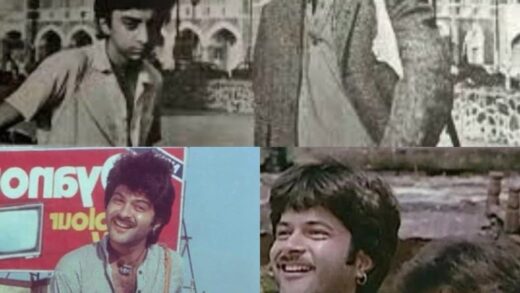


There are very few singers in Indian music whose voice can instantly transport listeners back to a different era. Lucky Ali is one of them.
For millions of people who grew up during the 1990s and early 2000s, songs like “O Sanam,” “Ek Pal Ka Jeena,” “Na Tum Jaano Na Hum,” “Safarnama,” and many others are more than just songs—they are memories.
Unlike most successful singers who carefully followed a traditional path into the music industry, Lucky Ali’s journey was remarkably unconventional. It was filled with family disagreements, personal struggles, failed expectations, years of uncertainty, and a relentless passion for music.
What makes his story even more fascinating is that he was born into one of the most famous film families in India. His father was the legendary comedian and actor Mehmood, one of Bollywood’s biggest stars.
Yet despite belonging to such a celebrated family, success did not come easily to Lucky Ali.
Growing Up as Mehmood’s Son
Lucky Ali was born as Maqsood Mahmood Ali into a family already deeply connected with Indian cinema.
His father, Mehmood, was among Bollywood’s most successful comedians and actors during the 1960s and 1970s. At the peak of his career, Mehmood’s popularity was so immense that audiences sometimes came to theaters specifically to watch him.
Being the son of such a famous personality brought both opportunities and challenges.
On one hand, Lucky had access to the world of films and entertainment from a young age. On the other hand, there was constant pressure associated with carrying the legacy of a superstar father.
However, Lucky Ali was never interested in following a conventional path.
Even as a young man, he was independent-minded and often found himself at odds with expectations imposed on him by society and family.
A Difficult Relationship with His Father
Several media interviews over the years have revealed that Lucky Ali’s relationship with his father was not always smooth.
During his younger years, disagreements between father and son became frequent. Lucky had a rebellious personality and preferred living life according to his own rules.
This often led to conflicts within the family.
Eventually, matters became so strained that Lucky decided to leave home.
It was a bold decision.
Most people would have preferred the comfort and security that came with being part of a famous family. Lucky chose uncertainty instead.
That decision would shape the rest of his life.
Leaving Home and Moving to Puducherry
After leaving home, Lucky Ali moved to Puducherry (then Pondicherry).
Life there was vastly different from the glamorous world of Bollywood.
Instead of film sets and celebrity gatherings, Lucky found himself working ordinary jobs to support himself.
One of the jobs he reportedly took was at an oil factory.
For many people, such work might have seemed disappointing, especially considering his background.
But for Lucky, this phase became an important period of self-discovery.
Living independently taught him resilience.
It also gave him the opportunity to understand life outside the privileged circles of the film industry.
Music Never Left Him
Even during his toughest days, one thing remained constant: his love for music.
Lucky always carried his guitar with him.
Whenever he found time away from work, he would sit alone and play music.
Music became his escape.
It became his companion during lonely days and uncertain nights.
Unlike many aspiring singers who dream solely of commercial success, Lucky was deeply interested in expressing emotions through songs.
He wasn’t trying to imitate anyone.
He wasn’t chasing trends.
He was simply creating music that reflected his own experiences and feelings.
That authenticity would later become his biggest strength.
Moving to Bengaluru and Discovering Farming
After spending time in Puducherry, Lucky eventually moved to Bengaluru.
There he stayed at his father’s farmhouse.
This period introduced him to an entirely new passion: farming.
Lucky developed a genuine love for nature and agricultural life.
Many people who have interacted with him over the years describe him as someone who feels more comfortable in natural surroundings than in glamorous celebrity environments.
During this phase, his daily routine often revolved around farming activities.
Yet music continued to occupy a special place in his life.
Whenever he wasn’t working outdoors, he would write songs, compose melodies, and experiment with different musical ideas.
These years may not have brought fame, but they helped him develop the artistic identity that would later make him unique.
The Birth of an Album Called “Suno”
Eventually, years of songwriting and experimentation resulted in something significant.
Lucky Ali completed work on his first album.
He called it “Suno.”
At the time, India’s independent music industry was still developing.
Unlike today’s digital era, musicians needed substantial support from record labels to reach audiences.
Creating an album was only the first challenge.
Getting it released was an entirely different battle.
For approximately four years, Lucky struggled to find the right platform for his music.
Record companies were not immediately convinced.
Many industry insiders believed that his style was too different from mainstream trends.
His voice lacked the polished perfection expected from commercial playback singers.
Ironically, that very uniqueness would later become the reason for his success.
Seeking Help from a Bollywood Superstar
According to accounts that have circulated over the years, Lucky approached a major Bollywood superstar for help.
The reason seemed logical.
His father, Mehmood, had reportedly helped that actor during earlier stages of the actor’s career.
Naturally, Lucky believed the actor might be willing to support him.
However, things did not go as expected.
The superstar reportedly did not take the album seriously enough to help bring it to market.
For Lucky, this was undoubtedly disappointing.
Yet setbacks were becoming a familiar part of his journey.
Instead of giving up, he continued searching for opportunities.
The Record Company That Changed Everything
Eventually, Lucky Ali approached one of India’s leading private music companies.
This meeting would prove to be life-changing.
Executives at the company liked what they heard.
They recognized potential in Lucky’s music.
However, they also had a condition.
The company wanted a song that could serve as a powerful commercial centerpiece for the album.
In simple terms, they needed a track capable of capturing public attention immediately.
Creating such a song was easier said than done.
Lucky now faced enormous pressure.
The future of his music career depended on delivering something extraordinary.
Creating “O Sanam”
The challenge pushed Lucky Ali to dig deep into his emotions and experiences.
The result was “O Sanam.”
Few could have predicted what would happen next.
Released as part of the album Suno, the song became an instant sensation.
Its haunting melody, poetic lyrics, and deeply emotional vocals resonated with listeners across India.
Unlike the flashy music videos dominating television at the time, “O Sanam” felt intimate and genuine.
It spoke directly to the heart.
The song became one of the defining tracks of the Indian independent music movement.
Even today, decades after its release, “O Sanam” remains one of the most beloved songs ever produced by an Indian artist.
Why “O Sanam” Became Timeless
Several factors contributed to the song’s enduring popularity.
1. Authentic Emotion
Listeners could sense genuine emotion in Lucky’s voice.
The song did not sound manufactured.
It felt personal.
2. Unique Singing Style
Lucky Ali’s voice was unconventional.
It carried imperfections, vulnerability, and sincerity.
These qualities made him relatable.
3. Memorable Lyrics
The song’s lyrics captured themes of longing, love, and nostalgia that connected with audiences across generations.
4. Simplicity
Rather than relying on elaborate production, the song allowed emotion and melody to take center stage.
That simplicity made it timeless.
Overnight Success
Following the success of “O Sanam,” Lucky Ali transformed from an unknown musician into a national sensation.
The album Suno became one of the biggest non-film music successes of its era.
Music channels played the video repeatedly.
Radio stations embraced the song.
Young listeners connected deeply with his music.
For perhaps the first time, an artist who did not fit conventional Bollywood standards had become a mainstream star.
Expanding Beyond Independent Music
After the success of his independent albums, Bollywood began paying attention.
Lucky Ali eventually sang several memorable film songs.
Some of his most famous tracks include:
- O Sanam
- Dekha Hai Aise Bhi
- Ek Pal Ka Jeena
- Na Tum Jaano Na Hum
- Aa Bhi Jaa
- Safarnama
Each song carried the distinctive emotional quality that became his trademark.
Unlike many singers who adapted themselves to industry trends, Lucky maintained his individuality.
A Different Kind of Celebrity
One reason fans continue to admire Lucky Ali is that he never seemed interested in celebrity culture.
He rarely chased publicity.
He rarely participated in industry politics.
He often disappeared from the public eye for long periods.
Instead, he preferred a quieter lifestyle centered around nature, travel, family, and music.
This distance from the glamour machine made him even more intriguing.
The Legacy of Lucky Ali
Today, Lucky Ali occupies a unique place in Indian music history.
He proved that authenticity can triumph over formulas.
He demonstrated that an artist does not need a perfect voice to move millions of people.
Most importantly, he showed that success often arrives after years of struggle, rejection, and persistence.
His story is not merely about becoming famous.
It is about staying true to oneself despite setbacks.
From working in an oil factory and living away from home to creating one of India’s most iconic songs, Lucky Ali’s journey remains an inspiring example of resilience and artistic integrity.
And perhaps that is why, even today, whenever “O Sanam” begins to play, listeners instantly feel transported back to a simpler, more emotional time.
Some songs become hits.
A few become classics.
“O Sanam” became a part of people’s lives.
And that is why Lucky Ali’s music continues to live on, generation after generation.
Disclaimer
This article is based on information published in various interviews, media reports, biographies, and publicly available sources discussing Lucky Ali’s life and career. Some personal anecdotes and behind-the-scenes accounts have been reported differently by different publications over the years. Readers are encouraged to refer to original interviews and verified sources for complete historical context. The purpose of this article is to present a biographical overview and celebrate Lucky Ali’s contribution to Indian music and popular culture.