
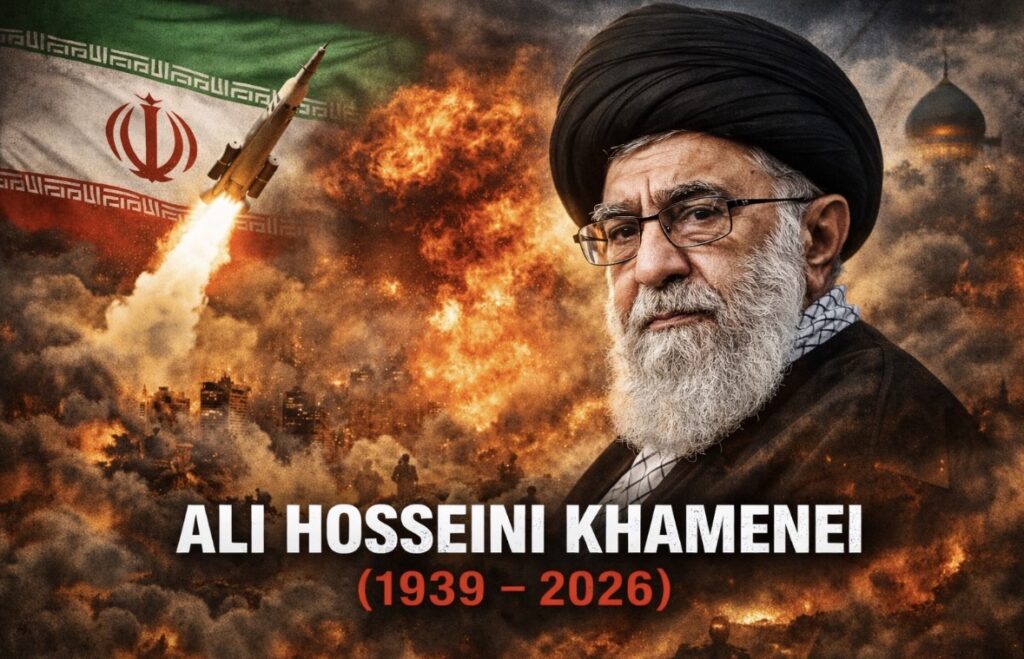
For over three decades, Ali Hosseini Khamenei shaped the Islamic Republic of Iran’s politics, religion, and foreign policy. His life reflected the seismic transformations in Iranian society following the 1979 Islamic Revolution — transitions marked by ideological fervor, domestic repression, and enduring conflict with Western powers, especially the United States and Israel. On February 28, 2026, Khamenei was killed during joint military strikes by the U.S. and Israel, a moment that not only ended his rule but also dramatically altered the course of Iranian governance and regional geopolitics.
Early Life and Formation (1939–1979)
Ali Hosseini Khamenei was born in 1939 in Mashhad, a major religious city in northeastern Iran, into a family with clerical roots. From a young age, he pursued religious education, studying Islamic theology and jurisprudence, and became involved in political activism opposing the secularizing policies of Shah Mohammad Reza Pahlavi. During this period, he aligned with revolutionary clerics and was repeatedly arrested for anti-monarchy activities.
His early association with figures like Ruhollah Khomeini positioned him within the orbit of what would later become the ruling elite of the Islamic Republic.
Post-Revolution Ascension (1979–1989)
Following the 1979 Islamic Revolution, which dismantled the Pahlavi monarchy and established the Islamic Republic, Khamenei assumed key roles in the new political system. He served in military and governmental capacities, including as Deputy Defence Minister, and was instrumental in organizing and strengthening the Islamic Revolutionary Guard Corps (IRGC) — a force that would become central to Iran’s political and security apparatus.
In 1981, a failed assassination attempt left him wounded but enhanced his prominence. He was subsequently elected President of Iran, serving two terms (1981–1989) during the protracted Iran–Iraq War and internal consolidation of the nascent Islamic state.
Supreme Leader (1989–2026)
Unanticipated Elevation
After the death of Ayatollah Ruhollah Khomeini in 1989, Khamenei was chosen as Iran’s Supreme Leader — the nation’s highest authority — despite initial skepticism about his clerical standing. The constitution was amended to satisfy formal requirements, empowering him to assume the position.
As Supreme Leader, Khamenei exercised ultimate control over Iran’s armed forces, judiciary, state media, and foreign policy, surpassing the influence of elected presidents and parliament.
Domestic Leadership and Controversies
Khamenei presided over nearly four decades of political developments, marked by:
Crackdowns on dissent: He oversaw suppression of major protest movements — notably the 1999 student demonstrations, the 2009 Green Movement after disputed elections, and the 2022 “Woman, Life, Freedom” protests after the death of Mahsa Amini in custody. Consolidation of power: Under his rule, Iran’s political institutions increasingly centralized around the Supreme Leader and connected military structures like the IRGC. Restrictions on civil liberties: Critics and human rights organizations accused his government of widespread repression, limiting free speech, and systemic violations. While his supporters saw him as defending national values and Islamic principles, opponents described his rule as authoritarian.
Foreign Policy and Regional Influence
Khamenei shaped Iran’s foreign relations with a confrontational stance toward Western powers and deep involvement in Middle Eastern geopolitics:
Anti-US and anti-Israel posture: He consistently labelled the U.S. as the “Great Satan” and opposed recognition or normalization with Israel. Support for non-state actors: Under his guidance, Iran supported proxy groups like Hezbollah, Hamas, and Yemen’s Houthis, contributing to its strategic presence across the region. Nuclear program: Khamenei oversaw expansive nuclear development, insisting on Iran’s sovereign right to enrichment while rejecting terms pushed by global powers.
Death Amid 2026 Conflict
February 28, 2026 marked a dramatic turning point. In the context of rising tensions over Iran’s nuclear program and escalating proxy confrontations with Israel and the U.S., a broad air campaign struck Tehran and other sites. Iran state media confirmed that Khamenei was killed in these strikes, and officials framed his death as martyrdom.
U.S. President Donald Trump publicly acknowledged the strike, describing Khamenei in strongly critical terms.
Reactions and Legacy
Domestic and Global Responses
Khamenei’s death sparked diverse reactions:
State mourning: Iran announced extended mourning, reflecting his status as the nation’s ideological leader. Mixed public sentiment: Some Iranians expressed relief or celebration over his passing, while others mourned. Global diplomatic concern: Leaders around the world warned of potential further destabilization in the Middle East and emphasized the importance of avoiding wider conflict.
Historical Assessment
Khamenei’s legacy is complex and contested:
Supporters credit him with sustaining Iran’s independence, resisting foreign domination, and maintaining social cohesion.
Critics argue his governance entrenched authoritarianism, hindered civil liberties, and contributed to regional instability.
Regardless of perspective, his nearly 37-year tenure profoundly shaped Iran’s modern political order and its relations with global powers.
Conclusion
Ali Hosseini Khamenei’s life — from a provincial cleric to Iran’s enduring Supreme Leader — mirrors the ideological evolution and geopolitical struggles of the Islamic Republic. His death in 2026 marks the end of an era while leaving uncertain prospects for Iran’s future direction, both domestically and internationally.
Authentic Source Disclaimer
This blog is based on credible news reporting from Reuters, Associated Press (AP), TIME, Indian Express, Khaleej Times, and other major global outlets published and updated as of March 1, 2026.