
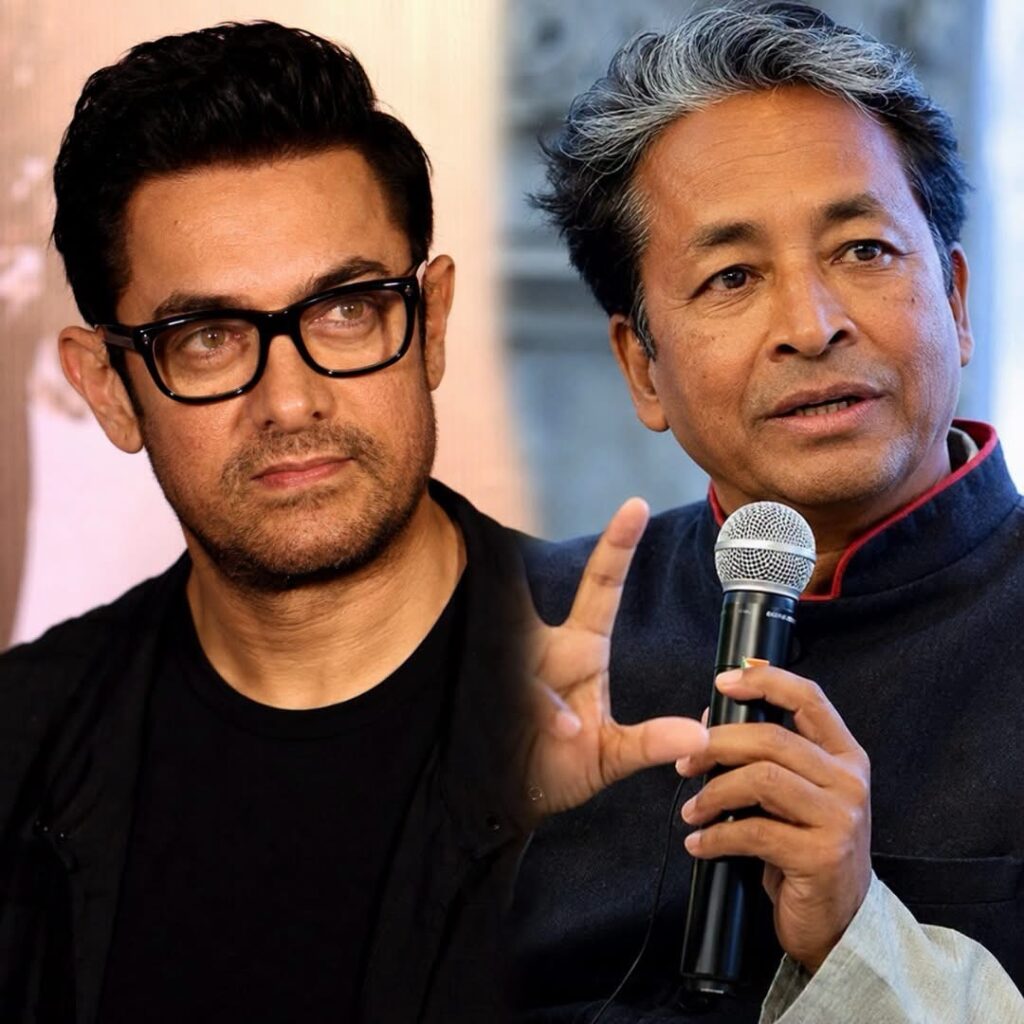
More than a decade and a half after 3 Idiots became one of the most talked-about Hindi films of its generation, a familiar question has returned to the spotlight: Was Aamir Khan’s iconic character Rancho, later revealed as Phunsukh Wangdu, inspired by Ladakhi engineer, innovator and education reformer Sonam Wangchuk?
For years, the connection between Wangchuk and the fictional Phunsukh Wangdu has been repeated in media reports, social-media posts and conversations about the film. Their similarities made the comparison easy to understand. Both are associated with unconventional education, innovation, practical problem-solving and Ladakh.
But a fresh exchange involving Aamir Khan and Sonam Wangchuk has reopened the debate.
Aamir Khan recently rejected the claim that his 3 Idiots character was based on Wangchuk, describing the association as a misconception. Wangchuk, meanwhile, has responded by recalling an interaction with Khan that he says took place before the film was released—and apparently before principal photography was completed.
Wangchuk also added humour to the controversy by referring to another famous Aamir Khan film, Ghajini, joking that perhaps the actor had experienced the kind of short-term memory loss associated with his character in that movie.
Behind the joke, however, lies a more complicated disagreement involving memory, chronology and the difference between a character being “based on” someone and being “inspired or influenced by” someone.
Here is what the controversy is actually about.
Why Is ‘3 Idiots’ Being Discussed Again?
Released in 2009 and directed by Rajkumar Hirani, 3 Idiots starred Aamir Khan, R Madhavan and Sharman Joshi as engineering students Rancho, Farhan and Raju.
The film became enormously popular not simply because of its comedy and performances, but because of its criticism of academic pressure, rote learning, obsession with marks and the idea that professional success should be valued above curiosity and creativity.
Aamir Khan’s Rancho stood at the centre of that philosophy.
Throughout most of the film, viewers know him as Ranchoddas “Rancho” Shamaldas Chanchad. The climax reveals a different identity: the brilliant inventor and educator Phunsukh Wangdu, living and working in Ladakh.
That final transformation is one reason audiences began connecting the fictional character with Sonam Wangchuk.
Wangchuk is known for his work in education and sustainable innovation in Ladakh. His real-world public profile—an innovator working on education and practical solutions in a Himalayan environment—made comparisons with Phunsukh Wangdu almost inevitable.
Over time, repetition helped turn the association into something many people regarded as an established fact.
But that is precisely what Aamir Khan has challenged.
What Did Aamir Khan Say?
During an interaction at the London Indian Film Festival in July 2026, Aamir Khan was asked about Wangchuk and the long-standing belief surrounding 3 Idiots.
Khan rejected the idea that Phunsukh Wangdu had been based on Sonam Wangchuk.
According to reports of his comments, Aamir said that he did not know about Wangchuk when 3 Idiots was being made. He also said director Rajkumar Hirani and writer Abhijat Joshi did not know Wangchuk at that stage.
His broader point was straightforward: according to him, the film’s character was not written as a portrayal of Sonam Wangchuk.
Aamir also made an important distinction. He praised Wangchuk’s work and indicated that respecting the education reformer did not require establishing a connection between him and a fictional Bollywood character.
In other words, Aamir’s position was not an attack on Wangchuk or his achievements. His disagreement concerned the history of the character.
The remarks attracted attention partly because the Sonam Wangchuk–Phunsukh Wangdu association had existed in popular culture for years.
The debate became even more interesting after an older account of a meeting between Aamir and Wangchuk resurfaced.
The 2008 Meeting That Complicated the Story
After Aamir’s comments received attention, reports highlighted an old video in which Wangchuk discussed meeting Aamir Khan in 2008.
According to The Indian Express, Wangchuk recalled meeting Aamir in Mumbai in April 2008 while he was there in connection with the CNN-IBN Real Heroes Award. Wangchuk said he spoke with the actor and discussed ideas, including a proposal concerning the Siachen conflict.
The timing matters.
3 Idiots was released in December 2009, but filmmaking obviously begins much earlier than a movie’s release date. A screenplay can also go through multiple drafts and revisions before and during production.
Therefore, evidence that the two men were at the same event or interacted before the film’s release does not automatically prove that Phunsukh Wangdu was based on Wangchuk.
At the same time, it explains why Aamir’s statement that he did not know Wangchuk during the relevant period attracted scrutiny.
The two questions are separate:
Did Aamir Khan meet or encounter Sonam Wangchuk before 3 Idiots was completed?
And:
Was Phunsukh Wangdu actually based on or influenced by Sonam Wangchuk?
Evidence supporting the first proposition does not by itself establish the second.
That distinction is essential to understanding the controversy fairly.
Sonam Wangchuk Responds With a ‘Ghajini’ Joke
The debate gained fresh momentum when Wangchuk addressed the issue during a podcast conversation.
Rather than launching an aggressive attack on Aamir Khan, Wangchuk responded with humour.
Referring to resurfaced footage in which Aamir could apparently be seen during an event where Wangchuk spoke, he jokingly connected the situation to Aamir’s 2008 film Ghajini.
In Ghajini, Aamir played a character suffering from a severe memory disorder. Wangchuk joked that because Aamir was apparently in his Ghajini look around the time of their encounter, perhaps he had also experienced “short-term memory loss.”
The remark quickly became headline material.
It was witty, instantly understandable to Bollywood audiences and directly linked two famous Aamir Khan films—Ghajini and 3 Idiots—to the same controversy.
But Wangchuk’s more substantive comments were more important than the joke.
He reportedly described his interaction with Aamir as more than a passing encounter and said they had discussed several ideas.
At the same time, Wangchuk stopped short of claiming that the entire character of Phunsukh Wangdu was a cinematic version of his life.
That nuance changes the nature of the debate.
Wangchuk Is Not Saying ‘3 Idiots’ Is His Biography
One of the biggest problems with the online debate is the tendency to reduce the issue to two extreme positions:
Either Phunsukh Wangdu was completely based on Sonam Wangchuk,
or Sonam Wangchuk had absolutely nothing to do with the character.
Wangchuk’s own reported comments leave room for a third possibility.
He has distinguished between something being based on a person and something being inspired or influenced by a person or their ideas.
Those are not the same thing.
A biographical character attempts, to some degree, to portray the life, personality or experiences of a real individual.
An inspired fictional character can be entirely different.
Writers regularly combine traits, experiences, professions, ideas and observations from many sources. Sometimes a fictional character resembles several real people without being a representation of any one of them.
Wangchuk has suggested that ideas discussed during his interaction with Aamir could potentially have had some influence, perhaps even indirectly or subconsciously.
That remains his interpretation rather than established proof of the film’s writing process.
And Wangchuk himself has acknowledged that 3 Idiots should not simply be described as his life story.
What Does the Resurfaced Video Actually Prove?
This is where social-media discussions often become misleading.
A video showing Aamir Khan listening to Wangchuk, or evidence establishing that the two interacted in 2008, can challenge an overly broad interpretation of the statement that they did not know one another.
However, it cannot by itself establish authorship or creative inspiration.
To prove conclusively that Phunsukh Wangdu was inspired by Wangchuk, much stronger evidence about the development of the screenplay would be required.
That could include dated screenplay drafts, notes from the writers, correspondence, interviews with the creative team or direct statements explaining how particular elements of Wangdu’s character were developed.
Without such evidence, the video is important primarily because of chronology.
It indicates that some form of encounter or interaction between Aamir Khan and Sonam Wangchuk was possible before the movie reached audiences and, according to Wangchuk’s account, before filming was completed.
That makes the timeline more complicated than a simple “they had never met” narrative.
It still does not settle the question of creative inspiration.
Omi Vaidya and the ‘Chatur’ Connection
Another person who helped bring the issue back into public discussion was actor Omi Vaidya, remembered by millions of viewers as Chatur Ramalingam from 3 Idiots.
Vaidya invoked the fictional Phunsukh Wangdu while publicly supporting Wangchuk.
The association attracted attention because it came from an actor who was part of the original movie.
Aamir responded by saying, in effect, that “Chatur” was wrong about the connection.
However, being an actor in a film does not necessarily mean knowing the complete history behind the development of another character. Unless someone was directly involved in the writing and character-development process, their recollection or understanding cannot automatically settle the matter.
Vaidya’s comments were therefore significant in reviving the conversation, but they should not be treated as definitive evidence that Wangdu was based on Wangchuk.
The same standard should apply to every side of the debate: claims should be separated from verifiable facts.
Why Did People Associate Rancho With Sonam Wangchuk in the First Place?
The connection did not emerge out of nowhere.
There are obvious thematic similarities.
Sonam Wangchuk has spent decades working around education, innovation and sustainability in Ladakh.
The fictional Phunsukh Wangdu is presented as an unconventional genius who rejects rigid academic thinking and eventually establishes an innovative learning environment in Ladakh.
Rancho’s philosophy throughout 3 Idiots is that education should focus on understanding and curiosity rather than memorising information simply to obtain marks.
Wangchuk’s public work in education naturally made audiences connect the two.
The geographical setting reinforced the association.
Had the fictional inventor lived somewhere completely different and worked in an unrelated profession, the comparison might never have become so widespread.
Instead, audiences saw a brilliant educational innovator in Ladakh and discovered a real-life educational innovator associated with Ladakh.
The narrative almost wrote itself.
But resemblance is still different from documented creative origin.
The Important Difference Between Rancho and Phunsukh Wangdu
Another reason the debate becomes confusing is that people often use “Rancho” and “Phunsukh Wangdu” as though they represent exactly the same aspect of the character.
Technically, the film’s narrative is more complicated.
For most of 3 Idiots, Aamir’s character appears as Rancho, the extraordinarily talented engineering student who challenges the college system and its authoritarian director, Viru Sahastrabuddhe, popularly called Virus.
Only toward the end do Farhan and Raju discover that the person they knew as Rancho was living under another person’s name.
His real identity is Phunsukh Wangdu.
The Ladakh-based inventor audiences meet at the end is therefore the adult culmination of the character’s philosophy.
When people compare Wangdu with Sonam Wangchuk, they are usually referring less to every detail of Rancho’s college story and more to the image of the innovative educator and problem-solver eventually revealed in Ladakh.
That distinction is important because nobody seriously suggests that Sonam Wangchuk literally lived all the events shown in Rancho’s fictional college journey.
The argument has generally been about inspiration, not biography.
‘3 Idiots’ Had Other Source Material Too
Any discussion about the origins of 3 Idiots also has to acknowledge the film’s connection with Chetan Bhagat’s novel Five Point Someone.
The movie drew from the novel while developing its own characters, situations and larger cinematic storyline.
The relationship between a novel and its film adaptation can be complex. Characters may be expanded, combined, rewritten or given entirely new arcs.
That means asking “Who was Rancho based on?” may itself be too simplistic.
A fictional character can emerge from source material, original screenplay development, observations of real people, thematic requirements and creative invention at the same time.
The existence of one influence does not necessarily exclude another.
Similarly, even if some elements associated with Phunsukh Wangdu resembled Wangchuk’s work, that would not automatically mean the entire Rancho character was “based on Sonam Wangchuk.”
That is why terminology matters so much in this dispute.
‘Based On’ vs ‘Inspired By’: Why the Words Matter
Consider three different statements:
“3 Idiots is based on Sonam Wangchuk’s life.”
“Phunsukh Wangdu is based on Sonam Wangchuk.”
“Some aspects of Phunsukh Wangdu may have been influenced by Sonam Wangchuk or his ideas.”
These statements make very different claims.
The first suggests something close to a biographical foundation for the movie.
That is difficult to reconcile with the actual plot and the film’s established literary and screenplay origins.
The second is narrower but still suggests that Wangchuk served as a principal real-life model for the character.
The third allows for a much smaller creative influence without claiming that Wangdu is a representation of Wangchuk.
Wangchuk’s recent position appears much closer to the third interpretation.
Aamir Khan, however, has rejected the idea that the character was based on Wangchuk and has said the filmmakers did not know of him when developing the film.
The gap between these positions is where the current controversy exists.
Could an Idea Have Entered a Film Without Becoming a ‘Based On’ Credit?
In principle, yes.
Creative works evolve continuously.
A film character can be substantially developed before production and still undergo changes later. Dialogue can change. Locations can change. Character traits can be strengthened. Visual details can be added. A climax can be modified.
Writers and actors are also exposed to countless conversations, books, news stories and people during the creative process.
But saying that something could happen is not evidence that it did happen in this particular case.
Wangchuk has reportedly raised the possibility that ideas from their interaction could have influenced Aamir and then entered the creative process consciously or subconsciously.
It is an interesting hypothesis.
It remains a hypothesis unless corroborated by evidence from the film’s development.
This is precisely why the controversy cannot responsibly be reduced to “Aamir lied” or “Wangchuk is wrong.”
The available accounts raise legitimate questions, but they do not conclusively establish the creative genealogy of Phunsukh Wangdu.
Why the Controversy Has Become So Popular Again
The debate contains almost every ingredient required for a viral Bollywood story.
There is an enormously popular movie.
There is one of India’s biggest film stars.
There is a well-known real-life innovator.
There is an old video.
There are apparently contradictory memories.
There is another actor from the same film entering the conversation.
And finally, there is a perfect pop-culture punchline involving Ghajini and short-term memory loss.
For social media, that combination is irresistible.
The Ghajini joke in particular transformed what could have remained a technical argument about chronology into an instantly shareable story.
Even people who have not followed Wangchuk’s work closely understand the reference because Aamir’s Ghajini character and his memory condition became such a familiar part of Indian popular culture.
But viral humour should not replace the factual question at the centre of the debate.
What We Know and What Remains Unproven
Based on currently reported information, several points can be separated reasonably clearly.
3 Idiots was released in 2009 and became closely associated with debates about India’s education system.
Aamir Khan’s fictional character is ultimately revealed as Phunsukh Wangdu, an innovative educator/inventor associated with Ladakh.
For years, Wangdu has frequently been linked in popular discussion with Sonam Wangchuk.
Aamir Khan has now explicitly rejected the claim that the character was based on Wangchuk and has said that he, Rajkumar Hirani and Abhijat Joshi did not know about Wangchuk while developing the film.
Wangchuk has recalled meeting Aamir Khan in 2008 and discussing ideas with him.
Reporting on the resurfaced account places that interaction before 3 Idiots reached cinemas and during the broader period surrounding the film’s development and production.
Wangchuk does not claim that 3 Idiots is a biography of his life.
Instead, he has suggested the possibility of influence or inspiration.
Most importantly, no publicly established evidence cited in the current round of reports conclusively proves that the character was directly modelled on Wangchuk.
That last point deserves emphasis.
A timeline inconsistency and proof of creative inspiration are two different things.
The Debate Also Says Something About How Bollywood Myths Are Created
There is a broader lesson in this controversy.
Popular culture frequently converts complicated stories into simple facts.
A film contains a fictional innovator in Ladakh.
A real innovator from Ladakh becomes nationally famous.
People notice similarities.
Articles repeat the association.
Social media repeats those articles.
Eventually, “possibly inspired by” becomes “inspired by,” and “inspired by” becomes “based on.”
After enough repetition, audiences may no longer remember where the original claim came from.
This phenomenon is not unique to 3 Idiots. It happens frequently with movies supposedly inspired by real events or people.
That is why primary accounts from filmmakers, writers and the people allegedly portrayed become important.
In this case, however, even those accounts have produced more questions rather than completely closing the matter.
Does This Controversy Change the Legacy of ‘3 Idiots’?
Probably not.
Regardless of where every individual element of Rancho or Phunsukh Wangdu originated, the character became one of the most recognisable figures in modern Hindi cinema.
For millions of viewers, Rancho represented a rejection of the idea that examination scores alone determine intelligence.
The film challenged parental pressure, unhealthy competition, rote learning and the stigma attached to failure.
Its famous philosophy of pursuing excellence rather than simply chasing success resonated far beyond engineering colleges.
Similarly, Sonam Wangchuk’s real-life work does not require a Bollywood connection to be significant.
This was also an important part of Aamir Khan’s response: Wangchuk’s achievements can be respected independently of whether a fictional character was based on him.
That may actually be one area where the opposing sides are closer than social media makes them appear.
Wangchuk has also previously resisted being reduced simply to “the real Phunsukh Wangdu.”
A real person’s decades of work are inevitably more complicated than a fictional character designed for a three-hour movie.
So, Was Rancho Really Inspired by Sonam Wangchuk?
The most accurate answer at present is:
It remains disputed.
Aamir Khan says no—at least in the sense that Phunsukh Wangdu was not based on Wangchuk and the core creative team did not know of him while developing the character.
Sonam Wangchuk does not claim that the film is his biography, but he recalls meeting Aamir in 2008, says they discussed ideas and leaves open the possibility that some influence may have occurred.
The resurfaced account of their 2008 interaction adds an important piece to the chronology, but it does not by itself prove how the screenplay or character evolved.
That distinction is crucial.
If future interviews, production documents or statements from Rajkumar Hirani, Abhijat Joshi or other people directly involved in developing the screenplay provide additional detail, the historical picture may become clearer.
Until then, presenting either extreme as conclusively established would go beyond the available evidence.
Final Thoughts
Nearly 17 years after 3 Idiots first reached cinemas, it is remarkable that Rancho and Phunsukh Wangdu can still generate a national conversation.
The latest controversy began with a familiar question but became much bigger after Aamir Khan rejected the long-standing Sonam Wangchuk connection, an old account of their 2008 interaction resurfaced and Wangchuk responded with his memorable Ghajini joke.
The humour has made headlines, but the real issue is more nuanced.
Aamir Khan maintains that Phunsukh Wangdu was not based on Sonam Wangchuk.
Wangchuk accepts that the movie is not his biography but suggests that inspiration or influence cannot necessarily be ruled out, particularly given what he recalls as a substantive interaction with Aamir.
The public evidence of a pre-release encounter makes the history worth examining, but it still does not prove exactly what influenced the writers.
Perhaps that uncertainty is why the story refuses to disappear.
The question is no longer simply, “Is Sonam Wangchuk the real Rancho?”
A better question is:
Where does resemblance end and creative inspiration begin?
For now, Bollywood’s 17-year-old Rancho mystery remains exactly that—a fascinating but disputed piece of 3 Idiots history.
Disclaimer
This article is based on publicly available statements, interviews and media reports concerning Aamir Khan, Sonam Wangchuk and the film 3 Idiots. The question of whether Phunsukh Wangdu/Rancho was directly inspired by Sonam Wangchuk remains disputed. Statements attributed to the individuals mentioned in this article represent their respective reported accounts and should not be interpreted as independently established proof of the film’s creative process. The article is intended for informational and entertainment-news purposes and does not allege intentional misrepresentation by any individual.