
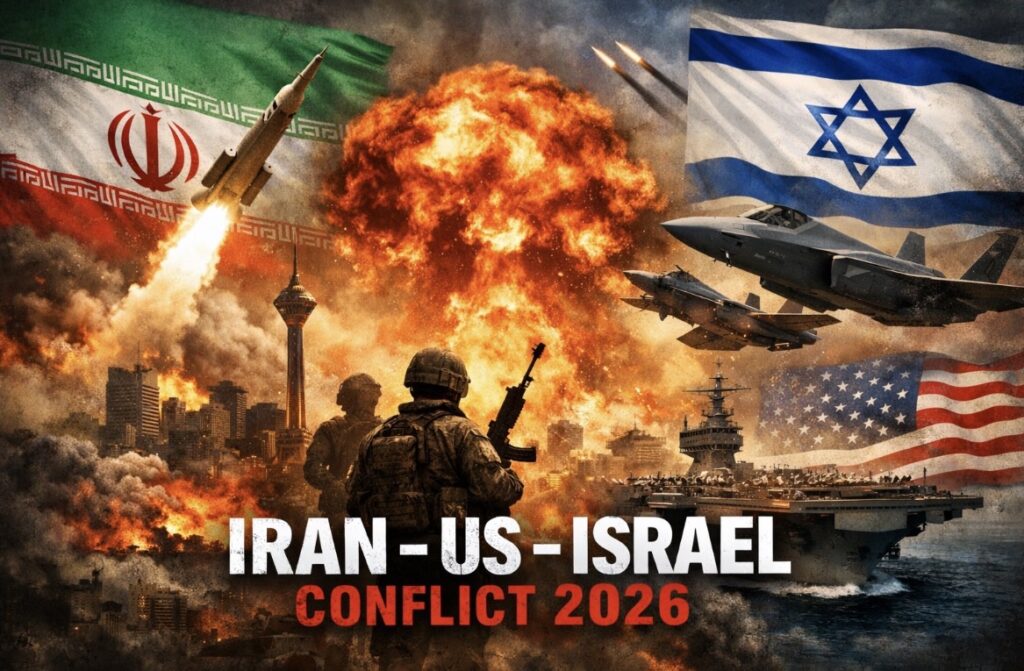
The early months of 2026 saw a dramatic escalation of hostilities in the Middle East involving the Islamic Republic of Iran, the United States, and Israel — thrusting the region into one of its most volatile confrontations in decades. What began as ongoing tensions over Iran’s nuclear ambitions and regional influence culminated in large-scale military strikes, widespread missile exchanges, and intense diplomatic fallout from global capitals. This blog aims to explain why the conflict erupted, what has happened so far, and what it means for the world — using verified information from reputed outlets such as Reuters, The Guardian, AP, Time, and others.
Historical Context: Longstanding Rivalries
The enmity between Iran and Israel predates the latest outbreak of violence but took on a new character after the 1979 Iranian Revolution, when Tehran severed ties with the West and Israel, labeling them adversaries in its regional ideology. Over the decades, Iran’s backing of militant groups like Hezbollah and Hamas and Israel’s deep concerns about a nuclear-capable Tehran set the stage for recurring escalations.
In recent years, tension was amplified by Iran’s nuclear program and mutual accusations: Israel insists Iran is racing toward nuclear weapons capability, while Tehran denies weaponization ambitions and accuses Israel (with U.S. backing) of aggressive interference.
June 2025 Conflict: A Prelude
Before 2026, the region had already seen major combat. In June 2025, Israel launched an extensive air assault on Iranian military and nuclear facilities (Operation Rising Lion), prompting Iran to respond with ballistic missiles toward Israeli territory — though the Iron Dome intercepted many of them. Hundreds were killed or injured in both countries during that exchange.
The campaign ended with a ceasefire on June 24, 2025, mediated by the U.S. and Qatar, but the underlying tensions remained unresolved — setting the stage for the explosive confrontation that followed in 2026.
February 28, 2026: Large-Scale Joint Strike
The most significant escalation came on February 28, 2026, when U.S. and Israeli forces conducted coordinated strikes deep inside Iran (termed Operation Epic Fury by U.S. planners and Lion’s Roar by Israel). These operations targeted Iran’s nuclear infrastructure, air defenses, and high-value military sites in cities including Tehran, Isfahan, Natanz, and Fordow.
Explosions were reported across Tehran, with conventional bombs and missiles used to degrade Iran’s defense and strategic nuclear capability. Some reports even noted damage to elite leadership compounds.
According to state media and official sources, the attacks resulted in the reported killing of Iran’s Supreme Leader Ayatollah Ali Khamenei — a development confirmed by multiple outlets and acknowledged by U.S. and Iranian authorities alike.
Iran’s Retaliation and Regional Impact
In response to the U.S.–Israel offensive, Iran launched widespread missile and drone strikes targeting both Israeli military positions and U.S. bases across the Gulf region. Tehran’s government characterized the strikes as reprisal attacks and vowed further retaliation against “aggressors” while appealing to regional actors.
The Iranian Revolutionary Guard and other defense units reportedly fired missiles toward U.S. bases and allied facilities throughout the region, including locations in Iraq, Kuwait, and the Gulf. Civilian and infrastructure impacts were reported on all sides.
Humanitarian and Civilian Toll
Beyond military targets, civilians bore a heavy burden. Panic spread throughout Iranian cities following the joint strikes, leading to mass displacement as families fled urban areas. Essential services — hospitals, schools, and transportation networks — faced severe disruption.
Reports emerged of tragic civilian casualties, including attacks near schools, which international observers and human rights groups have condemned. Leaders from several countries criticized attacks that affected non-combatants.
Global Diplomatic Response
The international reaction was swift and varied:
The United Nations Security Council convened an emergency meeting where Secretary-General António Guterres condemned the escalation and urged de-escalation. European allies called for restraint and a return to diplomacy, emphasizing the need to protect civilian lives. India’s Ministry of External Affairs issued a statement urging all parties to exercise restraint and prioritize dialogue to prevent broader conflict. Gulf countries issued advisories affecting airspace and flights due to growing regional insecurity.
Nuclear Arms Fears and Strategic Calculations
Underlying the violence is a persistent fear over nuclear proliferation. Western governments, particularly the U.S. and its allies, have long accused Iran of moving toward nuclear weapons capability — a charge Tehran denies, claiming its nuclear pursuits are peaceful. The alleged nuclear threat was cited as major justification for the February 28 operation.
Israel, which has never officially acknowledged nuclear weapons but is widely believed to possess them, sees a nuclear-armed Iran as an existential threat. U.S. involvement has been justified by Washington as preventing a broader nuclear crisis and safeguarding allies.
Implications for Regional Security and Global Stability
1. Middle Eastern Balance
The conflict dramatically shifts regional dynamics. Iran’s strategic depth — including alliances with proxy groups and influence in Iraq, Syria, and Lebanon — could lead to ongoing instability.
2. Risk of Wider War
Escalatory cycles between Iran and Israel, compounded by U.S. direct involvement, raise the prospect of a larger international theatre if other states feel compelled to join or defend interests.
3. Global Economic Impact
Energy markets, global trade routes through the Strait of Hormuz, and airline operations have already been affected due to regional security warnings and airspace closures.
4. Humanitarian Crisis
Displacement, trauma, and destruction of infrastructure risk long-term destabilization and require urgent international humanitarian response.
Conclusion
The 2026 Iran-US-Israel conflict marks a significant, possibly historic, escalation in a long-running geopolitical rivalry. With deep roots in nuclear tensions, regional influence struggles, and decades of mutual hostility, the current confrontation underscores how localized disputes can rapidly escalate into wider international crises.
Whether diplomacy, deterrence, or further conflict will prevail remains uncertain, but what is clear is the global stakes involved — from nuclear strategy to civilian well-being and regional stability across the Middle East.
Authentic Source Disclaimer
This blog post bases its facts on verified reporting from Reuters, Associated Press (AP), Time, The Guardian, and other recognized international news organisations. News surrounding active conflicts evolves rapidly, and some details may change as reporting updates.